Why AI Training Matters More Than Ever for Business Teams
AI tools are changing quickly, but the bigger challenge for businesses is helping people use them consistently, safely and in ways that actually improve the work. Here's what useful AI training should look like.
AI tools are becoming more capable very quickly.
But buying access to an AI tool does not automatically make a team good at using it.
One person might be using AI every day.
Another might have tried it once and decided it was not useful.
Someone else might be quietly copying confidential information into a public tool because nobody has ever explained the boundaries.
And a manager might assume the whole team is using AI consistently when everybody is actually doing something different.
That is why AI training matters.
Not because every employee needs to become an AI expert.
They don't.
They need enough understanding to make sensible decisions about when AI is useful, which tool fits the job, how to check the result and when a person still needs to take responsibility.
What is practical AI training?
Practical AI training helps people use artificial intelligence safely and effectively in the work they already do. It should cover good prompting, context, checking outputs, responsible data use, choosing appropriate tools and applying AI to real tasks rather than teaching abstract technology theory.
The important word is practical.
People learn much more when the examples look like their working day.
An operations team needs different examples from marketing.
A salesperson needs different workflows from somebody preparing funding bids.
A senior leadership team needs a different conversation again.
The principles may be shared.
The work is not.
AI training should not be a tour of ChatGPT
ChatGPT remains a useful tool.
So does Microsoft Copilot.
But neither represents the whole AI landscape.
Teams are increasingly encountering tools such as:
- Claude
- Gemini
- Perplexity
- Grok
- Microsoft Copilot
- ChatGPT
- Claude Cowork
- Codex
- AI agents
- plugins and connected workflows
The useful skill is not memorising where every button sits.
Interfaces change.
Products change.
Features move.
What lasts longer is understanding:
- how to give useful context
- how to ask better questions
- how to check an answer
- how to work with sources
- what information is appropriate to use
- which actions need human approval
- when another tool is better
- when AI should not be used at all
That is why GrowthZone AI takes a platform-neutral approach.
Principles first. Platforms second.
Why should different departments receive different AI training?
Because they do different jobs.
It sounds obvious, but a surprising amount of training ignores this.
A marketing team may want help with research, brand voice, content workflows and repurposing.
A sales team might care about meeting preparation, proposals, follow-ups and CRM administration.
Operations teams may be looking at reporting, documents, repeated administration and information handling.
Bid and funding teams need careful support around research, evidence, structure and drafting while keeping verification firmly human.
Manufacturing teams may find useful opportunities in office administration, procedures, reporting and organisational knowledge before they ever look at complex factory-floor AI.
Leadership teams need to understand governance, risk, accountability, data and how to make sensible decisions about adoption.
Giving all of those people exactly the same two-hour presentation is unlikely to produce the same useful outcome.
Do employees need to be technical to learn AI?
No. Good business AI training should be understandable to people who do not consider themselves technical.
You do not need to understand how a large language model was built to use one responsibly.
You do need to understand its limitations.
You need to know that a confident answer can still be wrong.
You need to know what information should not be entered into an unapproved tool.
You need to know how to give enough context to get a useful answer.
And you need to know when the final judgement still belongs to you.
That is far more valuable than turning everybody into an amateur AI engineer.
Why does safe AI use need to be part of training?
Because employees are already experimenting.
In many organisations, AI adoption does not begin when leadership launches a formal programme.
It begins when somebody discovers a tool that makes a task easier.
That is understandable.
But it can create inconsistent habits.
Good training creates shared expectations around things such as:
- confidential information
- personal data
- approved tools
- checking generated content
- copyright and sources
- human approval
- accountability
Those guardrails do not need to make AI frightening.
They make it easier to use confidently.
Should a business train everyone at once?
Not necessarily.
There are several sensible starting points.
One person might need focused one-to-one support.
A small team might benefit from a two-hour practical session.
A department may need role-specific training.
An SLT may need a governance and decision-making session.
A larger organisation might train several groups in stages.
There is no prize for training the greatest number of people in the shortest time.
The right question is:
What do these people need to be able to do differently after the session?
What should people be able to do after AI training?
Useful AI training should leave people able to:
- recognise appropriate AI use cases
- use approved tools with more confidence
- give AI useful instructions and context
- check the quality of an output
- protect sensitive information
- understand where human judgement is required
- identify repeated work that may benefit from AI
- choose between tools more sensibly
- apply what they learned to their actual role
The aim is capability.
Not certificates for sitting through slides.
Does GrowthZone AI provide AI training in Newcastle?
Yes. GrowthZone AI provides practical AI training in Newcastle for individuals, teams, leaders and organisations, with sessions available at the workplace, at a suitable venue or online.
Find out more about AI Training in Newcastle.
What about the wider North East?
GrowthZone AI delivers in-person AI training across:
- Newcastle
- Sunderland
- South Tyneside
- North Tyneside
- County Durham
- Northumberland
- Teesside
- the wider North East
Online sessions are available across the UK.
See AI Training for Teams, Leaders & Organisations and AI Workshops North East.
What does this look like in a real organisation?
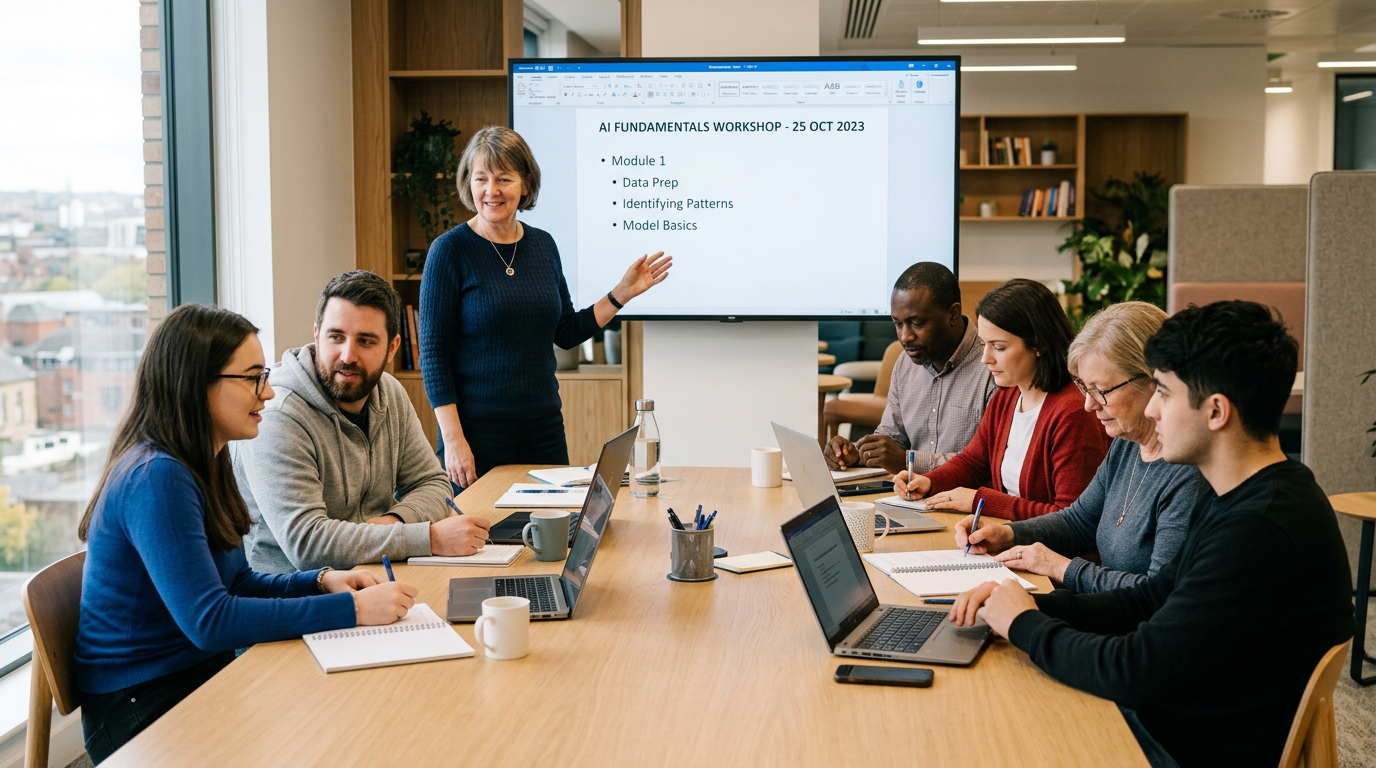
GrowthZone AI delivered a two-hour in-person Practical AI Workshop to seven members of the Bedmax team in Northumberland, alongside responsible AI guidance and guardrails.
The aim was not simply to demonstrate tools.
The session helped participants understand responsible AI use, prompting, different tools and where AI might genuinely improve processes across the business.
Why experience matters when choosing AI training
A trainer should understand more than the software.
They need to understand how businesses actually work.
Where pressure appears.
How departments interact.
Why a technically clever solution can fail if nobody uses it.
And why people need enough confidence to question AI rather than simply accept whatever it produces.
Kaye Nicholson brings nearly 30 years of real business experience into GrowthZone AI's training.
She has also been selected as an expert speaker for the UK Government Business Academy's AI programme and is a Bdaily columnist writing about practical AI and business.
See GrowthZone AI's partners, associations and community work
How do you choose the right AI training?
Do not start with:
"What AI course should we buy?"
Start with:
What do we need people to be better able to do?
Then decide:
- who needs the training
- what roles they perform
- what tools are already approved
- what problems are appearing
- how hands-on the session should be
- whether one session is enough
- what support may be needed afterwards
That produces much better training than simply picking the longest course on a list.
Frequently asked questions about business AI training
Do staff need previous AI experience?
No. GrowthZone AI can train complete beginners as well as teams already experimenting with AI. Sessions are pitched around the people in the room.
Can AI training be tailored to different departments?
Yes. Training can be adapted for leadership, operations, administration, marketing, sales, bids and funding, manufacturing, education and other specialist teams.
Do you only train people on ChatGPT?
No. GrowthZone AI is platform-neutral and can train teams across tools such as ChatGPT, Claude, Gemini, Microsoft Copilot, Perplexity, Grok, Claude Cowork and Codex where relevant.
Can you deliver AI training at our workplace?
Yes. In-person training is available across the North East, subject to availability and location. Online training is available across the UK.
Can one person have AI training?
Yes. One-to-one sessions are available for founders, directors, managers and employees who want focused support around their own role and workflows.
How long does AI training take?
GrowthZone AI offers formats ranging from focused 60 to 90 minute sessions through to two-hour sessions, half days, full days and multi-session programmes. The recommended format depends on what people need to achieve.
How is AI training priced?
Training is priced according to the format, duration, group size, level of customisation, delivery location and any follow-up support required. GrowthZone AI scopes the requirement first and provides a clear proposal before anything is agreed.

Written by
Kaye Nicholson
Founder, GrowthZone AI · Bdaily Columnist
Kaye Nicholson is the founder of GrowthZone AI and a columnist for Bdaily, helping businesses, charities, founders and teams use AI in simple, practical ways without jargon or overwhelm.
Book a short AI chatFound this helpful? Share it:
Reader feedback
Got a view on this week's AI Reality Check? Join the conversation on LinkedIn or send your thoughts directly.
Get the AI Reality Check weekly newsletter
Weekly practical AI updates for UK businesses: what changed, what it means, and what to watch next.
Planning AI training?
Tell us who needs it and what they do. We will recommend a practical format.
Get in touch